What does a "100% AI company" even mean? And as a business owner, why should I want one?
I’ve spent months thinking over this question. I didn't just think about it; I experimented and failed couple of times.
Here is the honest story of how I got here, the traps I fell into along the way, and the framework that finally cracked the code.
🛑 Not enough capacities
Last year, we hit a painful wall.
Demand was high, but our capacity was not. On three or four separate occasions, we had to do the unthinkable:say to the interested customer, "No, we can't take you on right now."It’s an incredibly frustrating feeling. People are literally knocking on your door throwing money at you, and you have to lock the door and say no (to many of those people it means pernament no and they will not cooperate.
I knew I had to scale. But my first three attempts to fix it led me straight into three different traps.
❌ Trap #1: The Traditional Scaling Trap (More Humans)
My first instinct was the classic one: just hire more people.
In just 8 months, I scaled the team from1 employee to 15.
- The Expectation:More hands = more freedom for me and more capacity for clients.
- The Reality:My salary burn rate increased, but my capacity did not. Instead of focusing on clients,80% of my day was spent managing internal operations, onboarding, and training. There was some progress, but very, very slow.
I was running a chaotic training camp instead of profitable company. More people didn't give me more capacities (only barely). I failed.
❌ Trap #2: The Hyper-Automation Trap (Rigid Systems)
Next, I turned to classic automation (think Zapier, Make, custom scripts). I tried to automateeverything.
- The Expectation:Build tools for humans so they can do more work with same time
- The Reality:I've built a house of cards. Sure, setting up an automated workflow is easy, but it takes a lot of time to maintain and you need to keep training everything how to use the tools.
Within a few months, I had build large set of automations that but when things complex, they started to break. It was working as isolated tool only plus I now had to spent large portion of my time maintaining / improving the tools for the users. I failed again.
❌ Trap #3: The Pure AI Agent Trap (The Wild West)
Then, AI agents hit the market. I was ecstatic. I was one of the first to deploy them at a large scale.
- The Expectation:AI agents are smart, adaptive, and don't require daily 1-on-1 management meetings.
- The Reality:Pure AI agents are unpredictable overtime and expensive.
Imagine hiring an employee who does a brilliant job on Monday, but on Tuesday decides to do the task bit differently and it breaks the outcome. Agents lack stability. You cannot rely on them in complex business environment. Plus my API token bills increased a lot.Suddenly, I was same amount of money to Google and Anthropic I used to pay for human salaries.
💡 My Breakthrough:
After failing three time, I found the solution.
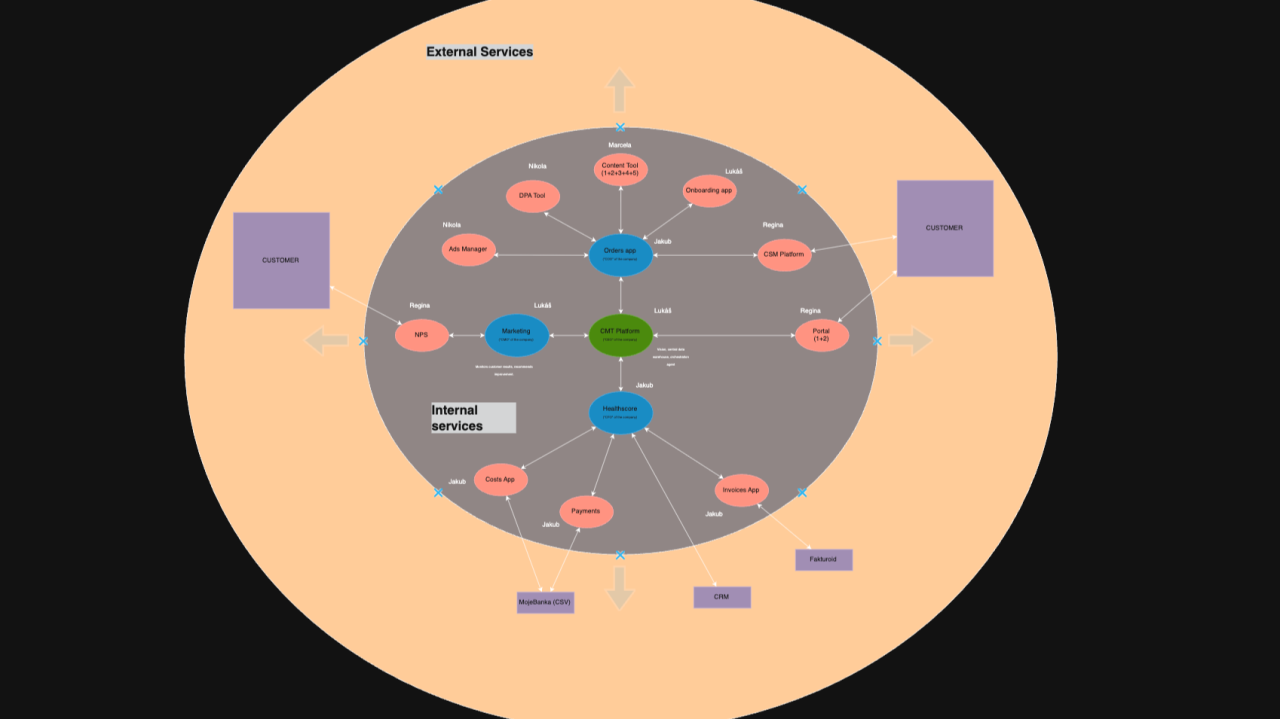
Instead of building fully "agentic" systems, I merged the previous attemps together. I used something agents are good at (coding) with something humans are good at (delivering quality) with software apps are good at (low operational costs and stability).I decided to build standard software applications, but instead of designing them for human users, I designed them specifically for AI agents.Think of it as anERP (Enterprise Resource Planning) system built exclusively for AI.Agents sends requests to the system, but it does not do the real job. Tokens costs are lower and output is stable (always the same). To ensure quality each app is overview by human controller who from time to time reviews if everything is working according well or not.
🏢 How It Looks Today: 19 Internal "Apps"
That lead me to built a ecosystem of these agent-facing apps. Right now, we have19 custom appsrunning our company.
We have a "CEO" app, a "CFO" app, a "CMO" app, and everything in between. They talk to each other seamlessly through rigid, cost-effective code, passing data back and forth without human friction.
But here is the most important part:The Human-in-the-Loop.
We haven't eliminated humans. We've just completely shifted their role.
- In a traditional company, the human does the grunt work, and AI is just a tool they use to type faster.
- In our company,the AI agent does 100% of the execution, and the human acts as the Editor-in-Chief.The human doesn't write the content, build the spreadsheet, or run the report. The AI agent presents the finished product, and the human simply checks the quality, gives feedback, and approves it.
Now our capacities are much higher. I don't need to hire 10 times the people to grow our revenue 10 times. I can do much more with what I have already.
I'll continue this article with more technical side of this. I'll also speak of new issues this setup brought to the company.